The Remedy for Everything but Death
Cairo, 1963. One seed. One crystal.
In 1963, in a laboratory in Cairo, Egyptian doctor Mahmoud El-Dakhakhny sets out to finish something nobody had bothered to. For decades, chemists had known the oil pressed from a small black seed did something in the body. They just could not say what. El-Dakhakhny went looking for the part that mattered.
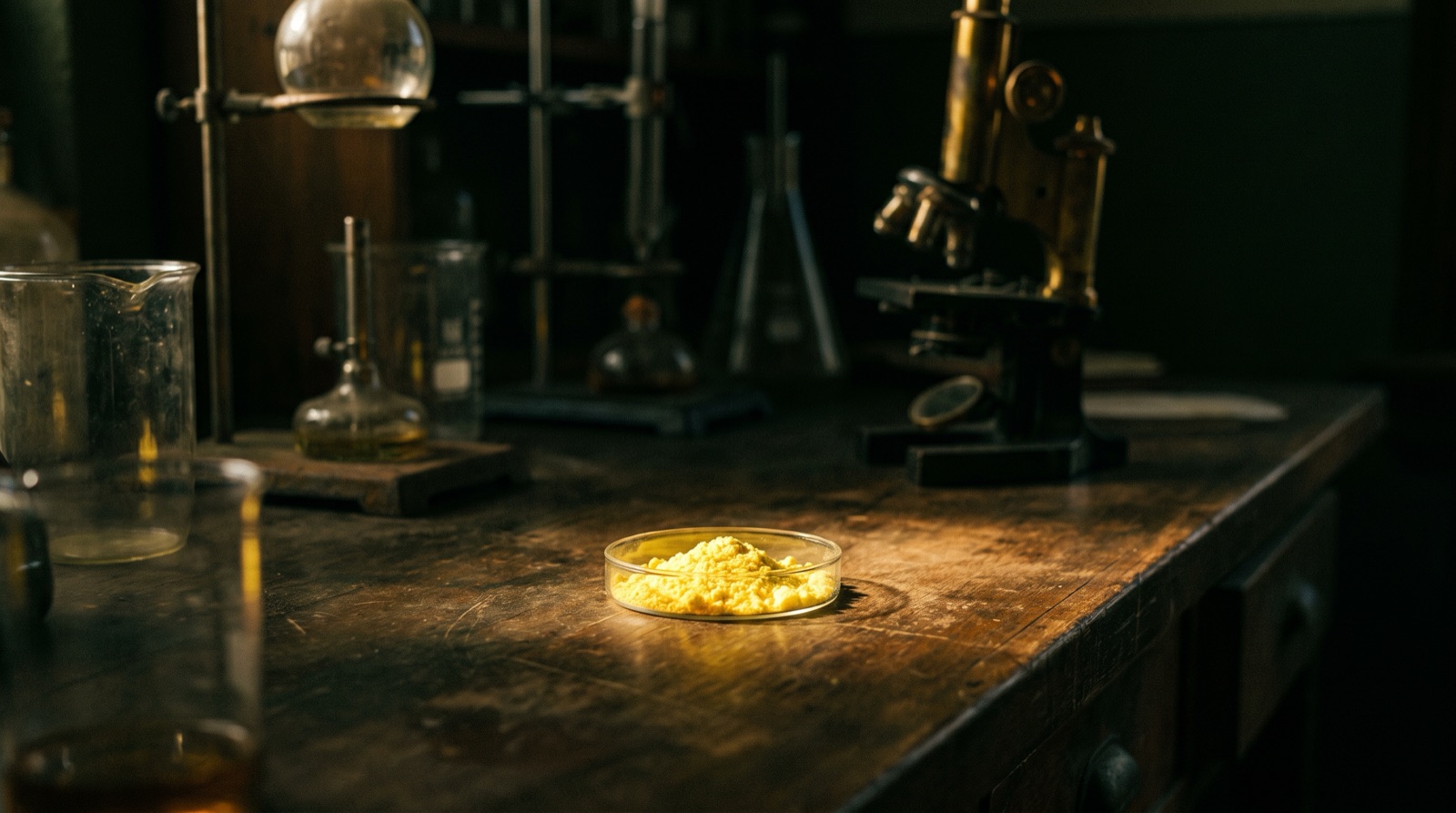
He worked the oil down, fraction by fraction, until he was left with a single bright-yellow crystalline compound. He measured it, named it, and published it in a journal called Planta Medica.
There it was. The reason it worked, in one compound.
He called it thymoquinone.
A remedy the ancient world had trusted for three thousand years, used by people who had no idea why it helped, had just handed up its secret to a man with a distillation flask. The seed was never magic. It was chemistry we had simply never bothered to read.
The seed is black seed. Nigella sativa. In much of the world it is still called the blessed seed.
And then, almost nothing happened. The finding sat. It did not make front pages. It did not change what your doctor learned in medical school. Sixty years later, most people reading this have never heard the name of the seed or the man who cracked it. That is not an accident, and by the end of this you will understand exactly why.

The seed older than the country
To feel how strange the silence is, you have to understand how long the world has trusted this seed.
Black seed is old. Older than the United States by a factor of nearly fifteen.
Archaeologists have recovered the seeds from a Hittite flask dated to roughly 1650 BC. In the first century, the Greek physician Dioscorides, whose writings governed Western medicine for the next fifteen hundred years, catalogued it by name. He called it melanthion, and among its uses he singled out the one this whole series has been circling: he recommended it to drive out worms.
From the Assyrians and the ancient Egyptians onward, black seed was a standard remedy for intestinal parasites, one of the very oldest uses on its long record.
A thousand years after Dioscorides, Avicenna devoted pages to it in the Canon of Medicine, the text that trained physicians from Baghdad to Bologna. And across the ancient world, one line followed the seed everywhere it traveled.
It was called a remedy for everything but death.
I want to be careful with that line, because it is powerful and it is often misattributed. It comes from a saying in the Islamic tradition, a hadith, and not from scripture, and it belongs in this story as history, not as a promise. But the history is the point. For three thousand years, across Greek, Roman, Persian, and Islamic medicine, the most serious healers alive kept reaching for the same small seed. They agreed on almost nothing else. They agreed on this.
What he named it, and what it is
So what did El-Dakhakhny actually find? Here is the whole thing in one line.
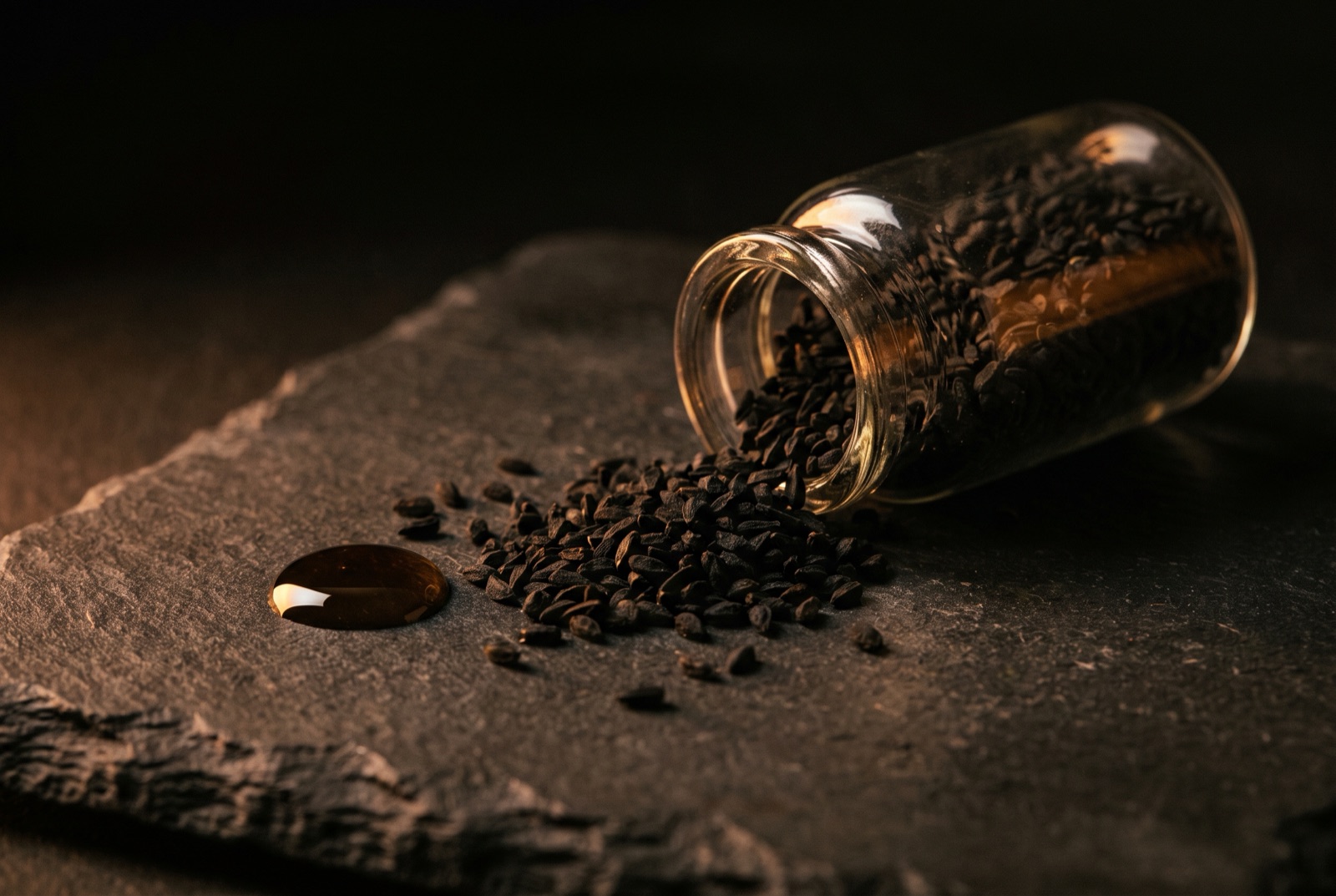
Nigella is the seed. Thymoquinone is the compound doing most of the work.
That is the difference between folklore and chemistry. For three thousand years, people used the seed the way you use a word you cannot spell: correctly, by feel, without knowing the mechanism. Thymoquinone is the mechanism, or at least the largest single piece of it. It is what modern laboratories now isolate, measure, study, and put through the same kind of trials as anything in a pharmacy.
So researchers did exactly that, for sixty years. What was settled in 1963 is simpler still: the seed carries a real, isolable, measurable active compound. The world just never acted on it.
What the world did with it
Or rather, the world acted on it everywhere except the one place you would expect.
In the sixty years since El-Dakhakhny, the research did not stop. It quietly compounded. Today there are hundreds of published studies on black seed and thymoquinone, and enough human trials that reviewers now pool them into systematic reviews and meta-analyses, the kind of second-order science you only get once a field has grown large enough to argue with itself.
Here is what the pooled human trials have found:
- Blood sugar dropped. Fasting blood sugar fell about 15 to 20 points. Here is what that looks like on a real person: a reading of 120, which a doctor calls "pre-diabetic," sliding back down to around 100, the top edge of normal. The longer-term measure (HbA1c, your three-month blood-sugar average) came down about 0.4 of a point, roughly the improvement most people get from losing several pounds or cutting the added sugar out of their diet.
- Cholesterol improved, all of it. The "bad" LDL cholesterol fell about 18 points, which for a typical reading is a 10-to-15% cut. Total cholesterol and triglycerides came down as well, and the "good" HDL actually went up. Getting all four to move the right way at once is something almost no single food manages.
- Blood pressure eased. About 3 points off the top number. Here is the concrete version: the largest review of blood-pressure studies ever done, more than 600,000 people, found that every 10-point drop cuts stroke risk by 27% and heart-disease risk by 17%. A 3-point drop is roughly a third of that step, so call it a high-single-digit cut in stroke risk, for free, from a seed.
- The scale moved. Without anyone in the trials being put on a diet, people taking black seed lost about 3 to 4 pounds and lowered their BMI, compared with those taking a placebo.
No single one of these is a miracle, and any one alone is easy to wave off. But line them up, steadier blood sugar, better cholesterol, lower pressure, a few pounds gone, and you are looking at almost the whole panel your doctor worries about at a routine checkup.
They are the kind of steady, repeatable numbers a drug company would build a campaign around, if only it could patent the source.
Which is the strange part. In laboratories from Cairo to Kuala Lumpur to Boston, thymoquinone is one of the more actively studied natural compounds on earth. In your doctor's office, it does not exist. The science kept catching up. American medicine simply never turned around to look.
Why not? Follow the money, the way I always do.

The oldest use is the one the lab keeps confirming
Black seed was a remedy for worms. Dioscorides put it in writing; the Assyrians and Egyptians used it that way long before him. The people reaching for it had no microscope and had never heard the word "protozoan." They only knew it did something.
And here is what gives me pause. Modern laboratories circled back to exactly that use, and put black seed's compound, thymoquinone, straight up against the parasites.
What they found, in the dish and in infected animals:
- Giardia, the parasite behind those bagged-salad outbreaks: thymoquinone killed 82 to 96 percent of it in lab tests, the number climbing the longer it was exposed.
- Entamoeba, the amoeba behind amoebic dysentery: up to about 97% killed in the dish over three days.
- Blastocystis, one of the most common gut parasites found in people: growth fully stopped, 100%, at a high enough dose.
- Schistosomiasis worms: in infected mice, black seed oil cut the worm burden by a third or more, and dropped the number of eggs those worms laid.
Different labs, different parasites, the same direction every time. For three thousand years the tradition ran out ahead of the proof. Ever since El-Dakhakhny, the proof has been quietly catching up.
The very first thing humans ever wrote down about this seed, that it drives out parasites from your body, is the thing the modern laboratory keeps confirming...

The reason you've never heard the name
Here is the reframe, and it is the most important sentence in this piece.
This is not an oversight. It is arithmetic.
A seed the world has grown for three thousand years "cannot be patented." And a remedy no one can own is a remedy no one will pay to prove. There is no company that captures the profit if a cheap, ancient seed turns out to help, so there is no company that funds the large trials, writes the treatment guidelines, or sends representatives to teach your doctor its name.
Watch the loop close on itself:
- No patent means no funding.
- No funding means no expensive late-stage trials.
- No trials mean no entry in the guidelines.
- No guideline means it never reaches continuing medical education.
- And a doctor who never meets it in training, in guidelines, or over a single sponsored lunch will, understandably, never mention it to you.
It is simply what happens to any remedy that cannot be owned: it falls through a system built, end to end, to move only the things that can. Your doctor is not the failure here.
Your doctor was handed a map with this seed erased from it. That is why you have never heard the name.
Why most of what's sold is worthless
So you go looking for it. You type "black seed oil" into a search bar, and a thousand bottles fall out. And here the story takes its most frustrating turn: most of them are not worth your money.
That is not my opinion. In early 2025, the independent testing lab ConsumerLab bought black seed oil products off the shelf and measured what was actually inside. The amount of thymoquinone, the very compound El-Dakhakhny isolated, ranged from as little as 2.7 milligrams per serving to as much as 77.5. That is a nearly thirtyfold gap between the strongest product and the weakest, all sold under the same three words on the label. Two of the seven products tested held far less thymoquinone than they claimed. One contained just 41.8% of what its own label promised.
Sit with that. You could do everything right, believe the history, believe the chemistry, spend your money, and still swallow a spoonful of oxidized oil with almost none of the compound that made the seed worth taking.
Black seed oil is fragile. Thymoquinone degrades with light, heat, and time; an oil that was real when it was pressed can be close to worthless by the time it reaches your cabinet.
The seed is not the problem. What the industry has done to the seed is the problem. The dividing line is simple, and almost nobody holds it: the oil has to be pressed and handled to protect the compound, and the compound has to be measured and verified, not assumed.
Standardized. Tested. Proven on the label instead of promised.

What comes next
If you have followed this series, you know the road that led here. I wrote to you about the parasites this country quietly stopped testing for. I gathered the whole problem into a field guide and called it what the CDC does: Neglected. And I told you the hardest part was not the parasites, but that we had disarmed ourselves, given up a defense our ancestors would never have surrendered. This seed is that defense, and today you finally have its name.
That is the standard we went looking for. I read what the old physicians actually wrote. I read what the modern laboratories are quietly finding. And I learned, the hard way, how much of what is sold under this seed's name would not survive an honest test.
Then we built something around the real thing, judged the way the ancients would have judged it and verified the way a modern lab can. I am not going to show it to you today. A piece whose job is to hand you back a name your doctor was never taught is not the place to sell you anything, and you have my word that when I do, it will be in plain language. This is the defense we gave up.
In the coming days, I will show you what we built to hand it back.

Your ancestor's kitchen had this. You never heard its name.
Here is where I will leave you.
Somewhere back up your family line, in a kitchen you never saw, there was very likely a small jar of these seeds. Your great-grandmother would have known what they were for. She would have reached for them without a second thought, the way her mother taught her, the way three thousand years of mothers taught theirs.
Yours has never heard the name. Not because the seed stopped working, but because it could not be owned, and so it was allowed to disappear. That is not an accident. And it is, at least, something you can undo.
Reply and tell me if your family ever used it. I read every one. And keep your eyes on your inbox, because what comes next is the part I have been waiting to show you.
To your health,
Antonio
CEO, Black Forest Supplements
